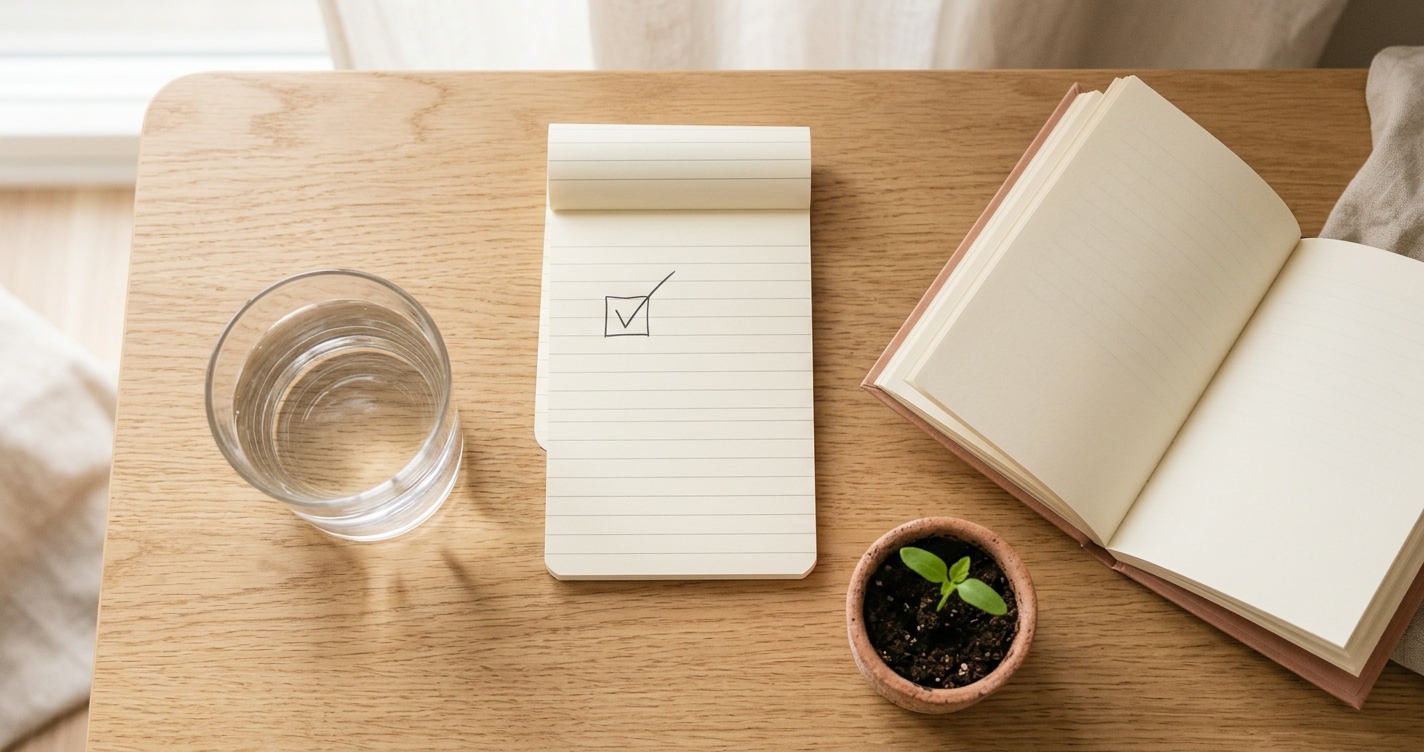
A few years back, I was really good at planning new habits and really bad at keeping them. Every January I’d write these ambitious lists. Wake up at 5 AM. Meditate for 30 minutes. Read 50 books. Work out six days a week. Journal every night.
I even did the 5am wake-up challenge once. Made it ten days. Then one morning my alarm went off and I just… didn’t. And that was that.
By February, I’d done exactly none of it consistently. Not because I lacked willpower — I’d white-knuckle my way through the first week just fine. The problem was that I was trying to become a completely different person overnight. And that’s not how brains work.
What finally changed things for me wasn’t a productivity system or a $200 planner. I tried those too, honestly. It was making my habits so small that skipping them felt harder than doing them.
What Micro Habits Actually Are
A micro habit is a behavior that takes less than two minutes. That’s the whole rule. If it takes longer than two minutes, it’s too big.
Instead of “meditate for 20 minutes,” you sit down and take three deep breaths. Instead of “read for an hour,” you read one page. Instead of “work out for 45 minutes,” you put on your workout shoes.
It sounds ridiculous. I thought it was ridiculous when I first heard about it. One page? That’s not reading. Three breaths? That’s not meditation.
But here’s what happened: I actually did it. Every single day. And after about three weeks, I noticed I was naturally reading for 15 or 20 minutes without thinking about it. The one page was just the entry point — the hard part was never the reading itself, it was the act of picking up the book.
Why Tiny Beats Ambitious
There’s solid neuroscience behind this. Your brain has a structure called the basal ganglia that handles habit formation, and it doesn’t care about the size of the action — it cares about the repetition. Every time you repeat a behavior in the same context, the neural pathway gets a little stronger.
When you set a massive goal, you’re fighting your prefrontal cortex the entire time. That’s the part of your brain responsible for willpower and decision-making, and it gets fatigued. It’s like a muscle that gives out after too much use in a day.
Micro habits bypass this entirely. They’re so small that your brain doesn’t register them as a threat. No resistance, no negotiation, no “I’ll start Monday.” You just do it.
James Clear talks about this as the “two-minute rule” in his work on habit formation. The idea is that the beginning of any habit should take less than 120 seconds. Once you’ve started, continuing is dramatically easier than the initial decision to begin.
7 Micro Habits Worth Starting Today
These are the ones that actually moved the needle for me. Not all at once — I added them one at a time, about two weeks apart.
1. One Glass of Water Before Coffee
Before I touch coffee, I drink one full glass of water. Takes about 15 seconds. After sleeping for 7-8 hours, your body is dehydrated, and starting with water instead of caffeine makes a noticeable difference in how you feel by mid-morning.
I’ve been doing this for over a year now, and the handful of mornings I skipped it, I could feel the difference — more sluggish, more brain fog, even with the same amount of coffee.
2. Write Down One Thing You’re Grateful For
Not a journal entry. Not a paragraph. One thing. Today mine was “working from home in Austin without having to commute.” It took four seconds.
Gratitude journaling has solid research behind it — a 2024 meta-analysis across 70 studies found that even minimal gratitude practices were associated with measurable improvements in well-being. But the keyword is “practice.” Writing one thing daily beats writing ten things once a month.
3. Two-Minute Tidy
Set a timer for two minutes. Pick up, put away, wipe down — whatever you can get done before the timer goes off. That’s it.
Two minutes won’t deep-clean your apartment. But doing it every day means your space never reaches that overwhelming “I need three hours and a hazmat suit” level. It’s maintenance mode instead of crisis mode.
4. Read One Page Before Bed
One page. You’ll almost always read more, but you only have to read one. On my worst, most exhausted nights, I’ve read exactly one page and closed the book. And that’s fine — I still kept the streak alive.
Over the past year, this “one page” habit has gotten me through around 23 books. Not because I’m disciplined. Because starting is easy.
5. 60-Second Stretch After Sitting
If you work at a desk, set a reminder to stand up and stretch for 60 seconds every hour. Reach your arms up, touch your toes, twist your spine, roll your neck. Done.
I think remote work means most of us sit way more than we realize. My lower back pain that I’d been seeing a chiropractor about? It’s not gone, but it’s about 70% better. And I didn’t add a yoga routine or buy a standing desk — I just started interrupting my sitting.
6. One Deep Breath Before Responding
When someone says something that triggers a reaction — an annoying email, a comment that rubs you wrong, a text that makes you want to fire back — take one deep breath before you respond.
One breath takes about four seconds. But it’s enough space to switch from reactive to intentional. I’ve avoided maybe a dozen unnecessary arguments this year just from that four-second pause.
7. Put Your Phone in Another Room at Bedtime
This isn’t even a habit you actively do — it’s a habit of removal. When you head to bed, leave your phone charging in another room. Buy a cheap alarm clock if you need one.
The first three nights were uncomfortable. I kept reaching for the nightstand out of reflex. By night four, I was falling asleep faster. By week two, my sleep quality had noticeably improved. No app, no sleep supplement, no sleep meditation podcast — just physical distance from the screen.
How to Actually Build Them
Starting micro habits is easy. The tricky part is consistency. Here’s what worked for me:
Stack them onto existing habits. Don’t create a new routine from scratch — attach the micro habit to something you already do. I drink water before coffee because I’m already walking to the kitchen. I stretch after I stand up from my chair. The existing habit is the trigger.
Track with the simplest possible method. I use a paper notebook — not an app, not a spreadsheet. Something I can see without unlocking a device. I tried a habit-tracking app once. Lasted about three weeks before I forgot to open it. The paper calendar on my wall is still going. The visual chain of marks becomes its own motivation — you don’t want to break the streak.
Never miss twice. You’ll miss days. That’s normal and fine. The rule is just: never miss two days in a row. One miss is an accident. Two misses is the start of a new (bad) habit.
Start with one. Not three, not five, one. Get it locked in for two weeks, then add another. I tried adding four at once early on and none of them stuck. Sequential beats simultaneous.
The Compound Effect Is Real
Here’s the math I keep coming back to. If you get 1% better at something each day, after a year you’re 37 times better. If you get 1% worse each day, you’re down to nearly zero. The gap between those two trajectories is enormous, but on any given day, the difference is invisible.
That’s both the power and the frustration of micro habits. You won’t feel different after a week. You probably won’t feel different after a month. But six months in, you’ll look back and realize you’ve read more books, slept better, managed your stress differently, and maintained a cleaner space — all from changes that never took more than two minutes.
Personally, I think the reason most habit advice fails people is that it asks too much too fast. You don’t need a morning routine that takes two hours. You need one thing that takes 15 seconds, done every single day.
The person who reads one page a day will always out-read the person who plans to read for an hour but never starts. Consistency beats intensity, every single time.
Start with one. Make it tiny. Do it today.