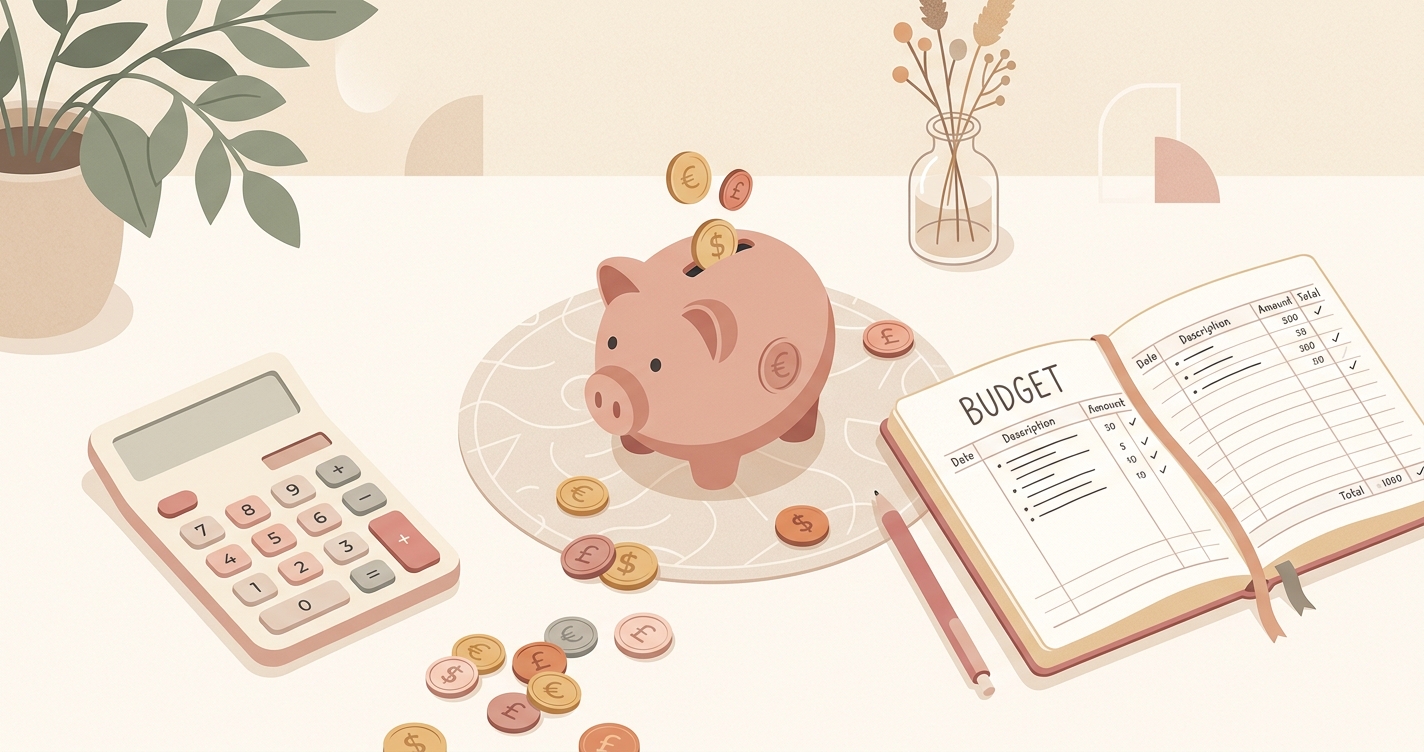
The 50/30/20 rule doesn’t work when your needs are eating 95% of your income. Here’s what actually does.
When your take-home is around $1,800 a month and your fixed expenses land at $1,650, there’s nothing left to distribute. You’re not failing at budgeting — you’re using a system built for people with surplus. The fix isn’t discipline. It’s a different method.
What I Tried That Didn’t Work
I went through the usual options.
The 50/30/20 rule. Textbook advice: 50% needs, 30% wants, 20% savings. In practice, needs were taking 91% of what I made. The math didn’t work and it made me feel worse, not better.
“Just track your spending.” I downloaded Mint, logged everything for three weeks, stared at the numbers, and then… nothing changed. Knowing where the money went didn’t tell me how to make it go somewhere better.
Cutting subscriptions first. Every personal finance article leads with this. I canceled everything I could find — about $47/month total. It helped a little, but my real problem wasn’t subscriptions. It was timing. More on that in a second.
The failure that actually cost me: I ignored the calendar problem for too long. Rent hit on the 1st, insurance auto-drafted on the 15th, credit card minimums clustered around the 20th. My paychecks landed on the 1st and 15th. On paper it looked fine. In reality, one paycheck covered rent and left $60 for two weeks. The $35 overdraft fee that hit in week two was a direct result of bill timing, not income. I paid that fee more than once before I figured out what was causing it.
For low-cash-buffer households, overdraft and penalty fees can turn a timing problem into a budget crisis. The CFPB bank account tools are worth reading if fees keep hitting at the same point in the month. That pattern hit differently once I realized it applied to me.
What Actually Changed Things
Fix Bill Timing First
Almost every service provider will move your due date if you call and ask. Landlords, insurance companies, credit card issuers — most will do it, no fees, no questions.
The goal: cluster your biggest bills right after your biggest paycheck.
If you’re paid on the 1st and 15th:
- Rent, car payment, insurance → 1st–5th
- Utilities, phone, credit card minimums → 16th–20th
This one change stopped my overdraft cycle entirely. No new income. No cuts. Just alignment.
Zero-Based Budgeting Over Percentage Methods
Zero-based means every dollar gets assigned before the month starts. Income minus planned expenses equals zero — not because you spent everything, but because nothing is floating.
Here’s what $1,800/month actually looks like with this method:
Rent:               $750
Utilities:          $180
Groceries:          $250
Gas:                $120
Car insurance:       $95
Phone:               $35
Debt minimums:      $150
Buffer (checking):   $50
Savings:             $20
Extra to debt:      $150
Total:            $1,800
That $20 in savings looks embarrassingly small. It is small. It’s also $240 by the end of the year, and more importantly, it’s the habit. The amount grows later. The habit has to exist first.
The reason this works over percentage methods: it starts from what you actually have, not what you’re supposed to have.
The Envelope System — Digital Version
Physical envelopes work, but I found digital easier to maintain. The principle is the same: money gets allocated to specific buckets at the start of the month, and when a bucket’s empty, that category is done.
Practically, this means separate accounts or a budgeting app with category tracking. I used YNAB starting in fall 2022. The free options — EveryDollar, Goodbudget — do the same thing at lower cost.
What makes this work psychologically is that the decision gets made once, upfront, rather than at every purchase. You’re not asking “can I afford this?” in the checkout line. You’re asking “does this category have room?” Those are different questions and the second one is easier to answer honestly.
Build a $100 Buffer Before Anything Else
Not an emergency fund. Not savings. Just $100 sitting in your checking account that you don’t touch.
This acts as overdraft insurance. The overdraft fee cycle ($35 per incident) is one of the most expensive things about being low-income, and a $100 buffer prevents almost all of it. Get this before you put extra toward debt. Before you save anything. It pays for itself in two or three months.
I built mine by selling things on Facebook Marketplace — some clothes, a charger I had duplicates of, a few books. One weekend, roughly $120. Not glamorous but it broke the overdraft loop.
Cutting Expenses: What’s Actually Worth It
When you’re already tight, most of the easy cuts are gone. Here’s where real money is:
Phone plan. If you’re on Verizon or AT&T, you’re probably overpaying by $30–50/month. Mint Mobile ($15–30/month), Visible ($25/month), or your carrier’s prepaid tier uses the same towers. Check coverage maps by ZIP code before switching.
Car insurance. Call and ask for every available discount. Good driver, bundling, low mileage, paperless billing. Then raise your deductible from $500 to $1,000 if you have the buffer to cover it — this alone typically saves $200–400/year.
Food. Store brands save 20–30% versus name brands on average. Building meals around rice, eggs, beans, frozen vegetables, and oats cuts the bill further. I was spending $450+/month on groceries before I got deliberate about it. Closer to $290 now, same number of meals.
Subscriptions. The average American carries $219/month in recurring charges. Go through your last two bank statements, not your memory — most people undercount by $80–100. Cancel everything, add back only what you used at least weekly in the last month.
Two Things That Don’t Work Like You Think
Cutting fun money entirely. I tried this. Lasted about 18 days before a bad week wrecked everything. Give yourself $10–20 of “no explanation needed” money every month. It sounds counterproductive. It’s not.
Monthly budget reviews. Too infrequent when money is tight. Spend 10 minutes on Sunday checking: what’s left in each category, any upcoming expenses, anything that auto-drafted unexpectedly. Weekly review catches problems before they compound.
On Increasing Income
Cutting has a floor. Income doesn’t.
This is worth saying even though it’s uncomfortable: if your income genuinely cannot cover housing, food, and utilities, a budget is not the solution. Look up 211.org to find local assistance, check your state’s SNAP application (benefits.gov), and ask your utility company about LIHEAP — most people who qualify for this program don’t know it exists. Benefits.gov has a screener that takes about 10 minutes.
If you’re close but not quite there, an extra $200/month changes things significantly. Weekend gig driving runs $100–200 for 8–10 hours. Plasma donation pays $50–75 per visit twice a week. Overtime at current job, if available, is time-and-a-half. None of these are long-term — they’re bridges while the budget system takes hold.
Common Questions
How do I budget if my income changes every month?
Use the lowest month from your last three as your baseline. When you earn more, put the difference toward your buffer or debt. This prevents overspending in good months without wrecking you in lean ones. I still do this. My income varies month to month and planning around the low end is the only thing that keeps it stable.
What’s the best free budgeting app for beginners?
EveryDollar’s free tier is the simplest to start with — zero-based, takes about 15 minutes to set up. YNAB has a 34-day free trial and is more powerful, but there’s a learning curve. Goodbudget works well if you’re splitting finances with someone else.
Should I save or pay off debt first?
Build the $100 checking buffer first. Then a $500 starter emergency fund. Then attack debt. Without the buffer, every small emergency pushes you further into debt and wipes out your progress. The order matters.
Is it worth budgeting if I only have $50 left after bills?
Yes. $50 without a plan disappears by mid-month with nothing to show for it. $50 with a plan is $20 to savings, $20 to debt, $10 you actually get to use. Small amounts managed intentionally accumulate. The habit matters more than the amount right now.
Kay is a self-employed freelancer and personal finance writer based in Austin, TX. Nothing here is professional financial advice — just what’s worked for her.