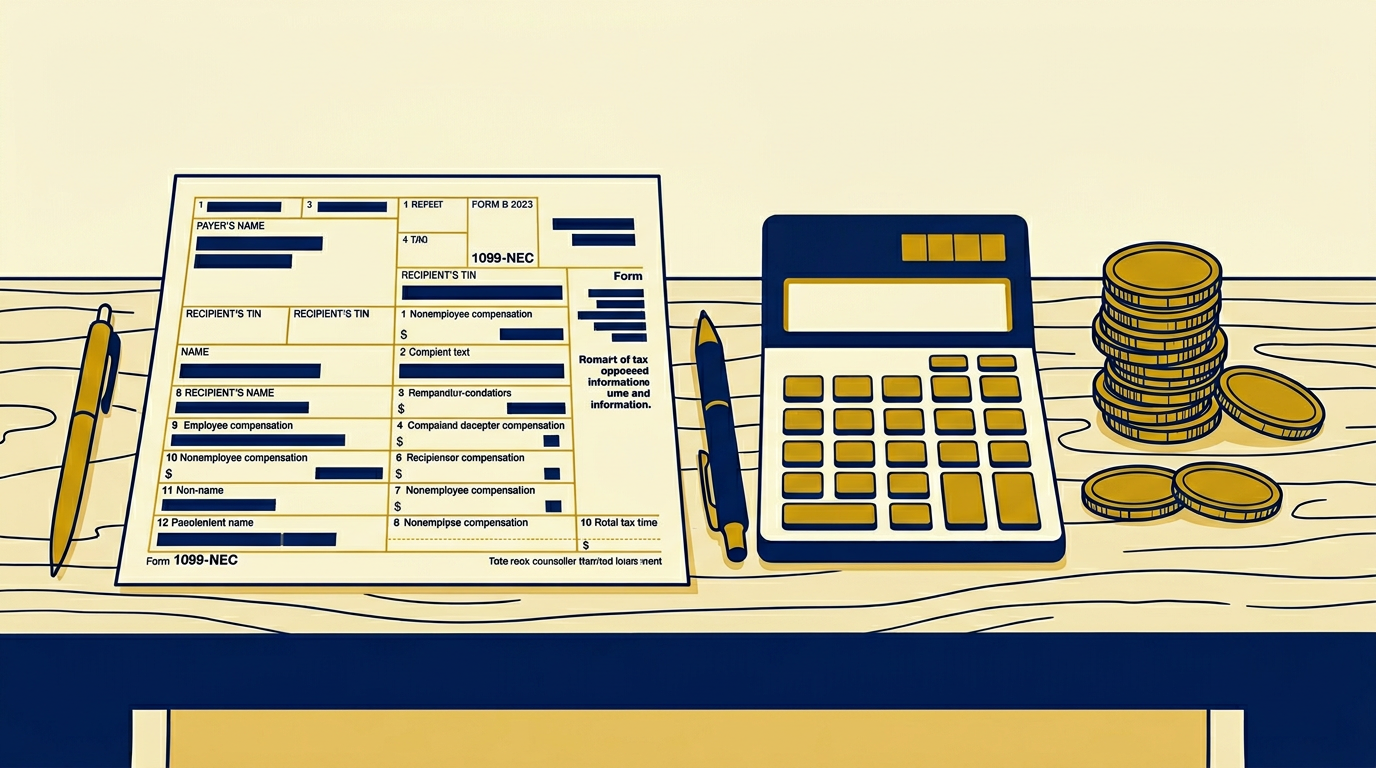
My first year running any kind of independent work, I received a 1099 for $4,200, assumed the tax situation would be similar to my W-2 income, and owed $1,100 more than expected when April came.
I paid it. I complained about it. Then I learned how it actually works.
The surprise wasn’t that I owed more — it was that nobody had told me there was a whole additional tax structure for self-employment income that W-2 employees never deal with. Here’s what that structure looks like and how to not get caught off guard.
The Self-Employment Tax
When you work as a W-2 employee, your employer pays half of your Social Security and Medicare taxes. When you work for yourself — freelance, side hustle, contractor, whatever — you pay both halves. That’s the self-employment (SE) tax.
2026 breakdown:
- Social Security: 12.4% on earnings up to $176,100
- Medicare: 2.9% on all earnings
- Additional Medicare: 0.9% on earnings over $200,000 (single)
On $10,000 of net side income, you’re looking at roughly $1,413 in self-employment tax before regular income tax even enters the picture.
The partial offset: you can deduct half of the SE tax from your gross income. So $10,000 of self-employment income means deducting about $706.50, which reduces your regular income tax slightly. It doesn’t eliminate the hit, but it reduces it.
Self-Employment Tax vs. W-2: What Changes
| Situation | Social Security | Medicare | Who Pays It |
|---|---|---|---|
| W-2 employee | 6.2% | 1.45% | Employee pays half, employer matches |
| Self-employed | 12.4% | 2.9% | You pay both halves |
| W-2 + side hustle | SE tax applies to side income only | — | You pay full SE tax on side income |
If you have a day job and a side hustle, your W-2 income already has FICA withheld. Your side hustle income sits on top and owes SE tax separately. They don’t offset each other.
Quarterly Estimated Taxes
This is where most first-timers get blindsided. If you expect to owe more than $1,000 in total taxes (income + SE tax) for the year, you’re supposed to pay the IRS quarterly — not just in April.
2026 due dates:
- April 15 — Q1 (Jan–Mar income)
- June 16 — Q2 (Apr–May income)
- September 15 — Q3 (Jun–Aug income)
- January 15, 2027 — Q4 (Sep–Dec income)
Missing these doesn’t mean anything catastrophic — it means you pay an underpayment penalty. The penalty is calculated based on how much you underpaid and for how long. Annoying, but not ruinous.
The safe harbor rule: if you pay at least 100% of what you owed last year (110% if your income was over $150K), you won’t be penalized even if you owe more this year. This is the simplest way to manage quarterly payments when your income fluctuates — just base them on last year’s tax bill divided by four.
Deductions That Actually Apply
This is where the pain of self-employment tax gets partially offset. The IRS allows business deductions on Schedule C that W-2 employees can’t take.
Home office. Two methods: simplified ($5 per square foot, max 300 sq ft, so up to $1,500) or actual (percentage of rent/utilities based on office square footage). The space must be used exclusively for work — a corner of the living room where you also watch TV doesn’t qualify. A dedicated room does.
Phone and internet. The business-use percentage. If you use your phone 40% for work, you can deduct 40% of the monthly bill. Keep a simple record of how you estimated that percentage.
Equipment and software. Laptop, external monitor, camera, microphone, software subscriptions — deductible in the year of purchase under Section 179. I deducted my entire studio equipment setup the year I bought it rather than depreciating it over several years.
Professional development. Courses, books, and subscriptions directly tied to your income-producing work.
Business travel. Only trips made specifically for client work — not personal travel where you do some work on the side. The distinction matters in an audit.
Health insurance premiums. If you’re self-employed and not eligible for employer-sponsored coverage, 100% of your health insurance premiums are deductible. This one is significant and often missed.
The Record-Keeping Minimum
You don’t need accounting software or a system. You need income received, expenses paid, and documentation for both.
My actual setup: a Google Sheet with four columns — date, amount, category, notes. Every time I get paid, I log it. Every time I buy something for work, I log it and take a phone photo of the receipt. Takes about 5 minutes per week if I stay current. Takes 4 hours in March if I let it pile up.
The photo receipt system works fine. Digital is acceptable. The goal is being able to show a number to a CPA or auditor and point to documentation for it.
Setting Money Aside
For every dollar of side hustle income, set aside roughly 25–30% for taxes if your marginal federal rate is around 22%. More if you’re in a higher bracket. This covers SE tax + estimated federal income tax.
I keep a separate savings account labeled “taxes” — not “emergency fund,” not “savings,” but specifically “taxes.” Every time a payment lands, I transfer 28% to that account immediately. When quarterly payments are due, the money is already there. No scrambling, no stress.
When I skip this step — which I’ve done — tax time becomes a problem. The money gets spent on other things between payment and filing, and then April is genuinely painful.
One Structural Thing Worth Doing Early
Once you’re consistently making more than $60K/year from self-employment, talk to a CPA about whether an S-corp election makes sense. The structure allows you to pay yourself a “reasonable salary” and take the remaining profit as distributions, which aren’t subject to SE tax. The savings can be substantial — potentially $5,000–$10,000+ per year at certain income levels.
This isn’t worth the administrative overhead at lower income levels. But it’s worth knowing the option exists before you hit the point where it starts mattering.
I’m not a tax professional — this is a general overview. For anything complex, a CPA consultation usually pays for itself.
Source: IRS — Self-Employment Tax (Social Security and Medicare Taxes)
2026 Update: The Minimum Tax System I Would Use
The simplest freelance tax system is three buckets: operating money, tax money, and owner pay. Every payment lands in the operating account first. A fixed percentage moves to tax savings immediately. What remains is what you can use for expenses and pay. It is not fancy, but it prevents the most common self-employment mistake: treating gross revenue like spendable income.
The percentage depends on income, state, deductions, and whether you also have W-2 income. As a rough habit, many freelancers start by setting aside 25% to 30% of net business income until a tax professional gives them a better number. The exact percentage is less important than moving the money before it feels available. Waiting until quarter-end requires discipline at the worst possible time.
Recordkeeping is the other half. You do not need complicated software at the beginning. You need a separate business account, receipts for deductible expenses, invoices that match deposits, and a monthly review. If you use one card for business expenses, categorizing taxes becomes dramatically easier. Mixing business and personal spending is what makes tax season feel impossible.
Quarterly estimated taxes are not optional just because no one is withholding from your payments. If you expect to owe enough, the IRS generally expects payments throughout the year. Missing that can mean penalties even if you pay the final bill by the April deadline. Put the quarterly dates on your calendar now, then review income two weeks before each one.
Official starting points: IRS Self-Employed Individuals Tax Center and IRS estimated taxes. This article is informational, not tax advice. Freelance taxes vary enough that a CPA can pay for themselves quickly once income is consistent.
The Line I Would Not Cross
The line I would not cross is spending money that has already been mentally assigned to taxes. Once the tax transfer moves, treat it as gone. Do not borrow it back for equipment, rent, ads, or a slow month unless you have already recalculated the tax need and know the money is truly excess.
This is especially important in the first profitable year. A side hustle can feel flush because no employer is withholding tax from each payment. That is an illusion. The tax bill is building in the background. The earlier you separate the money, the less emotional the quarterly payment feels. Taxes become an operating cost, not a crisis.
If the business is still tiny, keep the system tiny too. Separate account, saved receipts, quarterly reminders, and a tax bucket are enough to prevent most early chaos.
The other habit I would build early is a monthly closeout. On the last day of each month, record revenue, expenses, estimated profit, tax savings moved, and invoices still unpaid. This takes 20 minutes when the business is small. Waiting until tax season turns the same work into a weekend you will hate.